
Stone, C., Azarpeyvand, M., Croxford, A., & Drinkwater, B. (2025). Characterising bulk-driven acoustic streaming in air. Ultrasonics, 152, 107638.
https://doi.org/10.1016/j.ultras.2025.107638
Abstract
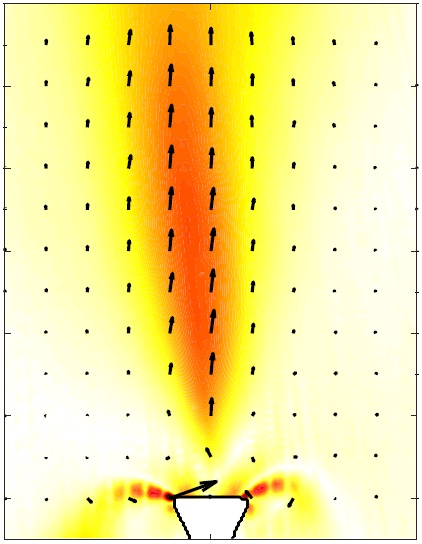
Bulk-driven acoustic streaming flows induced by two different high-powered ultrasonic sources in air have been measured and characterised using particle image velocimetry (PIV). These time-averaged flows are driven by the attenuation of the acoustic energy, and appear as jets in the direction of the acoustic propagation. Langevin horns and a focussed array of transducers, which operate at acoustic frequencies of 27kHz and 40kHz respectively, were used to create high pressure acoustic fields, with local sound pressure levels of over 160 dB. The magnitude of the acoustic streaming flows that resulted from the Langevin horn and the focussed array were up to 0.15m/s and 0.2m/s respectively. For a given peak acoustic pressure, the focussed array yielded higher acoustic streaming velocities due to the increased acoustic attenuation at the higher driving frequency. The shape of the acoustic field was found to govern the shape of the acoustic streaming velocity field, with the Langevin horn producing a wider jet with a more gradual velocity increase and decay than the focussed array. The focussed array induced a streaming velocity field where the maximum velocity occurred at a similar location to the peak acoustic pressure. Experimental PIV results were compared to a numerical model based on assumed weak non-linearity in which the attenuation of the first order pressure drives the streaming. The numerical model was able to predict the streaming velocity field with good qualitative and reasonable quantitative agreement.

 Bruce Drinkwater